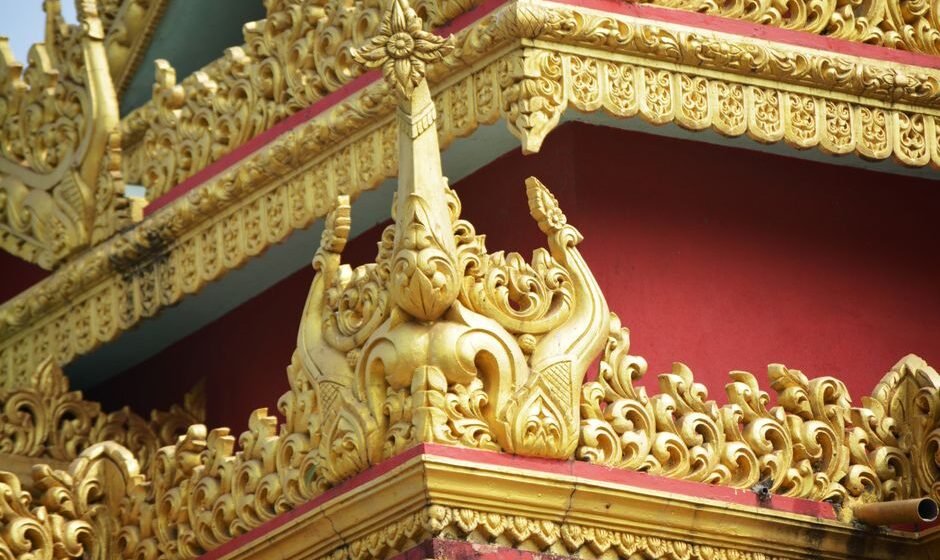

Near Mumbai stands one of the largest stone domes on earth, built to hold real relics of the Buddha and seat 8,000 meditators at once. It is called the Global Vipassana Pagoda, and it was Goenkaji’s long-held dream long before it became real.
Where It Is and What It Looks Like
The pagoda sits in Gorai, a coastal area in Borivali West on Mumbai’s northern edge, reachable by road or a short ferry ride. It stands 325 feet tall. The dome’s outer edge measures about 97.46 meters across, with an interior span of roughly 85.15 meters. The whole structure was built without a single supporting pillar inside.
That last detail is what makes it architecturally remarkable. It is recognized as the largest stone dome of its kind in the world, built entirely on self-supporting stone construction rather than steel or concrete columns holding up the roof.
Traditional stone dome construction like this had mostly disappeared from modern building projects, replaced by steel frames and reinforced concrete. Reviving it at this scale, for a meditation hall rather than a palace or cathedral, was itself an unusual engineering choice, one meant to echo ancient building methods rather than lean on modern shortcuts.
Modeled on a Burmese Original
The design is a deliberate echo of the Shwe Dagon Pagoda in Yangon, Myanmar, the golden pagoda that stands as Burma’s most famous Buddhist monument. That choice was not decorative. It was a direct nod to the country where Vipassana survived for centuries after it had largely died out in India, and where Goenkaji himself first learned the technique.
Fittingly, the people of Myanmar donated the marble used for the pagoda’s flooring, along with the ornamental umbrella that sits atop the dome.
Real Relics, Not Symbolic Ones
The pagoda was built specifically to hold bone relics of the Buddha. These were donated by the government of Sri Lanka and by the Mahabodhi Society of India. They were formally enshrined inside the pagoda on October 29, 2006, placed above the Dhamma Wheel at the top of the dome.
Why Build Something This Large
The main hall inside the dome can seat around 8,000 people meditating together at once, making it one of the largest meditation halls anywhere in the world. That capacity was the actual point. Goenkaji wanted a single space large enough to hold enormous group sittings, something no existing Dhamma center could offer.
Beyond that practical function, the project was framed as an act of gratitude. It honors Sayagyi U Ba Khin, the Burmese teacher who trained Goenkaji and whose lifelong wish was to see Vipassana return to India. That wish had already taken shape once before, in the 1970s, with Dhamma Giri, India’s first permanent center, near Igatpuri. It was also meant as a monument of peace and harmony, open to the public as a place to learn about the Buddha’s life and teachings, not only as a meditation venue for practicing students.
Built Without a Single Rupee of Government Money
Like every Dhamma center in this tradition, the pagoda was funded entirely through voluntary donations, not government grants or ticket sales. That is the same donation-driven funding pattern behind how a brand-new Vipassana center gets built anywhere in the world. Construction stretched across roughly a decade before the building was completed in 2008.
India’s then President, Pratibha Patil, formally inaugurated the pagoda on February 8, 2009, in front of thousands of meditators and guests. It was one more milestone in the same worldwide growth of Vipassana centers that had been building since 1969.
Today it is both a working meditation center and a public landmark. A separate teaching center on the same grounds, Dhamma Pattana, runs the actual short meditation courses held there. People who have never sat a single course visit anyway, drawn by the scale of what small donations from thousands of ordinary students can build together.
Meditators still use the dome regularly for large group sittings, exactly as Goenkaji intended. But most visitors who pass through its gates are tourists and curious locals, drawn by its size and history rather than a plan to meditate. Both kinds of visitors are welcome. That fits how Goenkaji always described the technique: open to anyone, regardless of why they first walked in.
Want to actually learn Vipassana? This article is independent, informal writing, not official teaching. The technique itself is taught only at free, residential 10-day courses run by the Vipassana Research Institute in the tradition of Goenkaji. You can find a course near you at dhamma.org.


