
Short answer: yes. You can sit a Vipassana course as an atheist, a Christian, a Hindu, a Muslim, or anything else, and you don’t have to adopt Buddhist belief to follow the instructions. This isn’t a workaround. It’s how the tradition itself describes the course, as covered in more detail in our piece on whether Vipassana is a religion.
But “you don’t have to believe” and “everything about the course will feel neutral to you” are two different claims. It’s worth being honest about the second one too.
What “Non-Sectarian” Actually Means Here
The course itself asks you to do one thing: observe your own breath and body sensations, without adding any belief system on top. No prayer to a specific deity happens during sittings. Nobody asks you to call yourself Buddhist afterward. Students from every religious background sit side by side, given the exact same instructions.
That’s a genuinely low bar to clear. You don’t need to accept rebirth, karma, or any metaphysical claim to follow the technique as taught. Plenty of strict atheists and committed believers of other faiths have completed the course without any conflict with what they already believe.
The One Real Requirement Is Behavior, Not Belief
There is one genuine requirement during a course, and it has nothing to do with religion, but it deserves to be stated plainly too. Every student, whatever they believe, commits to five basic moral precepts for the ten days: no killing, no stealing, no lying, no sexual activity, and no intoxicants.
Those precepts are not presented as Buddhist doctrine to accept on faith. They function as practical ground rules that make ten days of concentrated attention possible, similar to any retreat asking guests to avoid alcohol or dishonesty while sharing a small, structured space with strangers. All forms of prayer, worship, or religious ceremony are also set aside for the ten days, a rule that applies just as much to Buddhist students as to anyone else in the hall.
Where It Can Still Feel Unfamiliar
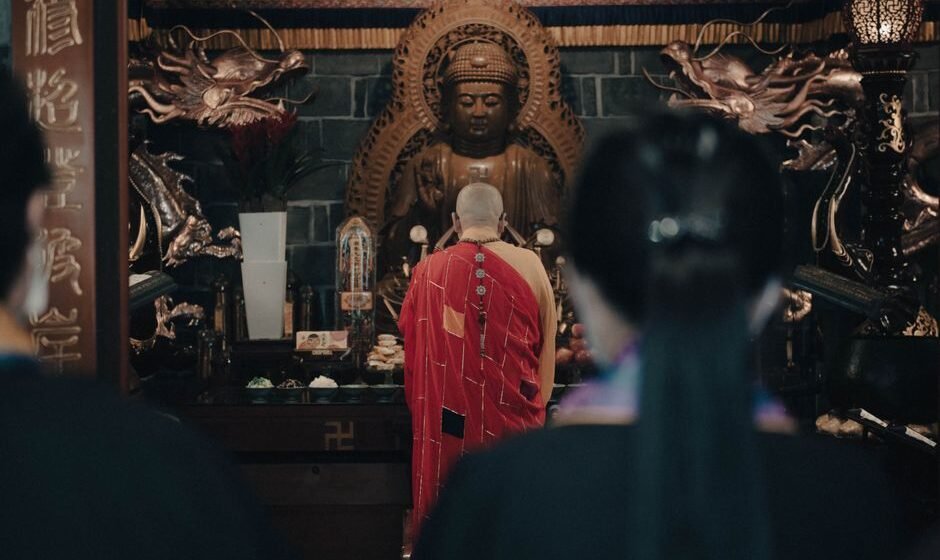
Here’s the honest part. A few things around the course carry a clear Buddhist flavor, even if they’re not framed as belief requirements. Group sittings open and close with chanting in Pali, the ancient language linked to early Buddhist texts. The teaching itself uses the word Dhamma constantly, and evening discourses reference the Buddha’s own teaching as the source of the technique.
None of that is presented as something you must believe. But if you’re a strict atheist, or you hold a different faith firmly, hearing chanting you don’t understand and references to a spiritual figure you don’t follow can still feel a little foreign for the first day or two. The reasoning behind the chanting specifically is worth understanding before you go, and it’s covered in why Goenka chants in Pali.
Fair Warning, Not a Deal-Breaker
None of this is a reason to skip the course if you’re curious. It’s simply fair to walk in knowing what you’ll encounter, rather than being caught off guard mid-sitting. Most people who go in expecting a fully secular, sterile environment adjust once they realize participation, not belief, is the only real ask.
If you can sit through ten minutes of chanting you don’t personally subscribe to, the same way you might sit through a moment of silence at an event tied to a tradition that isn’t yours, you’ll be fine. The actual instructions for the meditation itself stay strictly about observing your own sensations, nothing more.
It also helps to remember that the chanting and Pali terminology are presented as part of a specific historical lineage, not as claims you’re expected to personally endorse. Plenty of committed atheists sit through it every year, treat it as background rather than doctrine, and walk out having gotten exactly what they came for, as covered in more depth in what atheists and skeptics actually say about their Vipassana experience.
The Honest Takeaway
You don’t need to believe in Buddhism, or anything else, to do Vipassana and get real value from the technique. But expect a few moments, mostly chanting and language tied to Buddhist tradition, that a strict non-believer might find unfamiliar. Knowing that ahead of time makes it far easier to sit through without feeling blindsided.
Related reading:
Want to actually learn Vipassana? This article is independent, informal writing, not official teaching. The technique itself is taught only at free, residential 10-day courses run by the Vipassana Research Institute in the tradition of Goenkaji. You can find a course near you at dhamma.org.