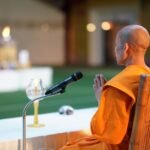

Somewhere around the fourth day of a Vipassana course, students hear a new word for the first time: adhitthana. It sounds intense, and in a way, it is. Here is what it actually means.
What the Word Means
Adhitthana is a Pali word, pronounced roughly ah-dee-tah-na. It translates to “strong determination” or “firm resolve.” It is not a technique on its own. It describes a quality of commitment applied to sittings students are already doing.
What an Adhitthana Sitting Actually Involves
From around day four onward, the daily schedule includes three specific one-hour group sittings, usually one in the morning, one around midday, and one in the afternoon. During these three sittings, students commit to something simple to describe but hard to do: sit for the full hour without opening the eyes, without moving the hands, and without changing the position of the legs.
That is the whole instruction. No special posture is required, and no particular breathing pattern. The commitment is just stillness, held for sixty straight minutes, even if the body gets uncomfortable.
Why Stillness for an Hour, Specifically
The point is not to prove anything or to punish the body. Adhitthana sittings exist to build a specific kind of mental strength, the ability to stay steady when something is uncomfortable, instead of immediately reacting to fix it. That steadiness is closely related to equanimity, the balanced state of mind Vipassana ultimately works toward.
In daily life, small discomforts get solved instantly, almost without thought. An itch gets scratched. A stiff leg gets shifted. None of that is wrong, but it also means the mind rarely practices simply staying with discomfort and observing it. The adhitthana sitting creates a small, safe space to build exactly that skill on purpose.
Not Endurance for Its Own Sake
It would be easy to mistake this for a toughness contest, gritting your teeth through an hour of pain to prove something. That is not the intention behind it. The sitting is meant to train resolve and steadiness of mind, not to test how much physical discomfort a person can tolerate.
This links closely to why discomfort shows up at all during a course, something covered in more depth in our piece on why physical pain is part of the Vipassana process. Adhitthana sittings are one structured place where that discomfort gets met directly, rather than avoided.
Why It Starts on Day Four, Not Day One
These sittings are not introduced on the first day. They begin once the course shifts into the main Vipassana technique itself, described more fully in our overview of what actually happens during a 10-day course. By day four, students have had a few days to settle into the schedule and the basic method, which makes the added commitment of an hour of stillness more realistic to attempt.
Students are never forced into these sittings against their will, and course staff make allowances for genuine medical needs. But for most people who are physically able, the sitting is offered as a real, if difficult, opportunity, not a mandatory ordeal.
Why This One Hour Sticks With People
Ask people who have completed a course what they remember most clearly, and the adhitthana sittings come up often. Not because they were pleasant, but because managing to sit through real discomfort without immediately reacting to it is a rare experience for most people. It tends to leave a mark long after the course ends.
What the Mind Does During That Hour
The first few minutes of an adhitthana sitting are usually the easiest. Discomfort tends to build gradually, not all at once, and with it comes a familiar pull to shift position, just slightly, just enough to relieve the pressure. That pull is the whole point of the exercise. Staying still is not about ignoring the discomfort. It is about noticing it clearly while choosing not to act on the urge to fix it immediately. This close, non-reactive attention to physical sensation is exactly what vedana, the sensation at the center of the whole technique, is about.
Most students find that sensations they assumed would only get worse actually change shape over the hour, sometimes fading, sometimes shifting to a different part of the body entirely. That shifting is itself a small, direct lesson in how little of what feels urgent in the moment turns out to be permanent.
Does Everyone Manage a Full Hour?
Not always, and that is treated as normal rather than a failure, especially since the middle days of a course are usually the hardest for most students. Some students move slightly during their first few adhitthana sittings and manage a full still hour only by the later days of the course. The instruction is offered as something to work toward with sincerity, not as a strict test with a pass or fail grade attached to it.
What matters more than a perfect record is the direction things move in over the ten days: a little steadier, a little calmer, one sitting at a time.
Want to actually learn Vipassana? This article is independent, informal writing, not official teaching. The technique itself is taught only at free, residential 10-day courses run by the Vipassana Research Institute in the tradition of Goenkaji. You can find a course near you at dhamma.org.