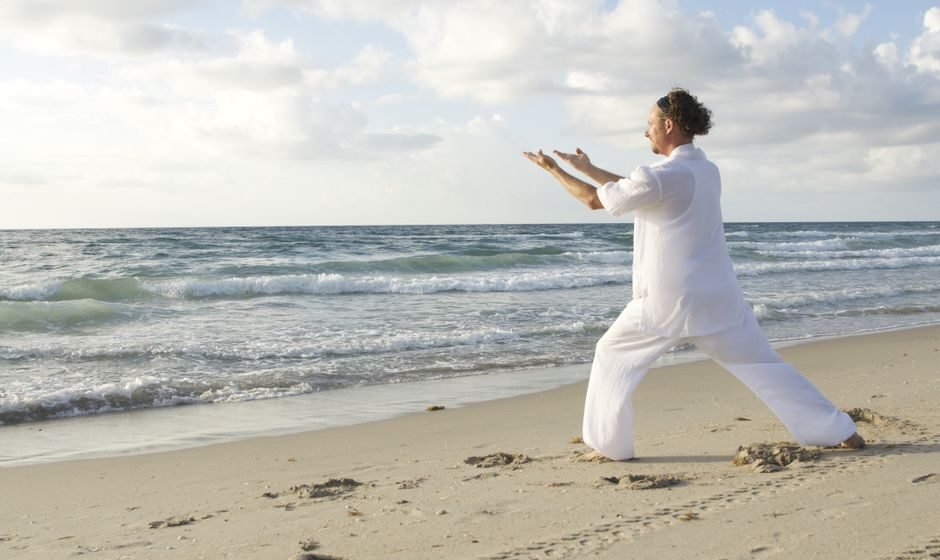

Stillness against movement
Walk into a park early in the morning in many parts of China and you will see groups moving slowly together, arms rising and falling in unison. That is qigong or tai chi. Walk into a Vipassana meditation hall and you will see the opposite: rows of people sitting completely still, eyes closed, for an hour at a time.
Both are described as meditative practices. Both claim real benefits for the mind. But almost everything about how they work is different.
What qigong and tai chi actually are
Qigong is the older and broader of the two. It comes out of Chinese Daoist tradition, going back thousands of years, and combines slow movement, breathing, and mental focus to work with what practitioners call qi, or vital energy. It sits alongside acupuncture and herbal medicine as a pillar of Traditional Chinese Medicine.
Tai chi grew out of that same broader tradition but started life as a martial art, developed for self-defense using slow, flowing, choreographed movements. Over time, its health and meditative side became just as important as its combat roots, and today most people practice it purely for balance, calm, and gentle exercise.
What Vipassana actually is
Vipassana comes from a completely different lineage, the Theravada Buddhist tradition, and it has no concept of energy moving through the body. Instead, students learn to observe physical sensation, section by section, while sitting motionless with eyes closed. There is no choreography and nothing to coordinate with breath in a set pattern beyond the earliest stage of the course.
The aim is not to build or balance anything inside the body. It is to watch sensation arise and pass away without reacting to it, building direct experience of how impermanent every physical feeling really is.
Moving with eyes open vs sitting with eyes closed
This is the most visible difference. Qigong and tai chi are almost always practiced standing, moving, and with eyes open, often outdoors or in a group class you can join for an hour and then get on with your day. Vipassana is done sitting, motionless, eyes closed, usually indoors, and the standard course runs for ten full residential days with no breaks to check a phone or run errands.
One fits neatly into an ordinary morning routine. The other asks you to set an ordinary routine aside completely for over a week, something also true of most structured silent retreat formats.
Social setting differs too. Tai chi and qigong classes are usually social, done in groups that chat before and after the session. Vipassana courses run under strict Noble Silence for most of the ten days, with no talking, no eye contact, and no gestures between students at all.
Different theories about what’s actually happening
Qigong and tai chi rest on a framework built around qi, the idea of a vital energy that can become blocked or depleted and needs to be cultivated and balanced through movement and breath. This idea sits at the center of Traditional Chinese Medicine as a whole.
Vipassana rests on a different framework entirely, rooted in Buddhist psychology. There is no vital energy to move or balance. There is only sustained attention to sensation, and the belief that clearly seeing sensation’s constantly changing nature slowly loosens old mental habits and reactions.
Where they might actually support each other
Some practitioners use both, at different points in the day or the week. Qigong and tai chi can help with physical stiffness, general fitness, and a calmer mood in daily life, and many people report better sleep from regular practice. Anyone weighing very different approaches side by side might also find it useful to see how Vipassana compares to float tanks, which take away almost all sensory input rather than adding movement. Vipassana works on something else entirely, a specific mental discipline aimed at deep insight, so the two rarely compete for the same slot in a person’s life.
Neither one replaces the other, and neither one needs the other to have value on its own terms.
The honest bottom line
Qigong and tai chi are moving practices built on the concept of energy, rooted in Chinese medicine and open to almost anyone in a single class. Vipassana is a still, seated practice built on observing sensation, rooted in Buddhist psychology, and taught only over a full ten-day residential course. They share the word meditation loosely, but very little else about how they actually work.
Related reading:
- Vipassana vs Digital Detox Retreats: Same Idea, Very Different Practice
- Vipassana vs Hypnotherapy: What’s Actually Different?
Want to actually learn Vipassana? This article is independent, informal writing, not official teaching. The technique itself is taught only at free, residential 10-day courses run by the Vipassana Research Institute in the tradition of Goenkaji. You can find a course near you at dhamma.org.